

Smart Financial Moves for November’s Holiday Spending

It’s that time of year again. November is the start of the holiday spending blitz. While many of us vow to start our holiday shopping earlier each year, the reality for most of us is that our lives are busy, and we tend to put this off until the holidays are near. With Black Friday and Cyber Monday coming up in November, it is time to make a holiday shopping plan. Create a Holiday Shopping Budget It is very easy to overspend during the holidays. It is a time of great joy and we enjoy giving gifts to family and friends that we think will make them happy. This desire to bring joy to family and friends can easily lead to overspending on gifts during the holidays. In order to keep your holiday spending in check, it is a good idea to create a holiday shopping budget. A good place to start is to list everyone that you will be giving a gift to. Next, take a look at your overall budget and financial situation to determine how much you can afford to spend on holiday gifts. This is an important step, and you should be as realistic as possible. This figure should be the amount you can afford to spend in cash right now, not what you are able to charge on a credit card. Once you have your holiday spending budget in place, you can then go down your list and prioritize these names. Close family will likely have the highest priority and will be the ones who you spend the most on. You might even go through the list and assign a dollar amount to each person’s gift. When shopping, refer to this list and try to stay as close to the dollar figures for each person as possible. Use Credit Cards Wisely It is fine to use your credit card for some or all of your holiday shopping, but doing so does not negate the need to watch your spending and to stick to your budget. Credit card bills do need to be paid and the last thing you want hanging over your head as we move into the new year is a bunch of credit card debt. Whether paying by credit card or with cash, be sure to adhere to your spending budget for each person for whom you are buying gifts. Using a credit card can have some advantages, including taking advantage of cash back offers that may be offered this time of year and the added accumulation of points on your card if the card offers a program like this. Either way, consider these perks a bonus instead of a way to justify overspending your budget. Preventing Holiday-Induced Financial Stress Many retailers and shopping sites offer incentives such as sales and other discounts to encourage people to shop with them. These offers are tempting, but be sure to stay on track with your holiday spending budget no matter how tempting the deal is. It is critical to stick with your holiday spending budget to help make the holidays less stressful. You already have enough going on with shopping, planning travel and get togethers, which can distract from realizing that you have overspent. There is no worse way to start the new year with a mountain of debt that far exceeds your spending budget. As part of tracking your holiday spending during November and December be sure to set aside the funds to cover any credit card debt that has accumulated during the holidays. This will help reduce any post-holiday financial strain and will help you start off the new year on a positive note financially. We all want to have a happy holiday season. Giving family and friends gifts they will love and cherish is rewarding, but it is important to do this within your financial means and not to let holiday spending put a damper on your overall financial situation. Need help with the mechanics of setting a spending budget? Contact your Wedbush financial advisor. Disclosure Wedbush Securities does not provide tax or legal advice. Please consult your tax or legal advisor. These materials are provided for general information and educational purposes based upon publicly available information from sources believed to be reliable — we cannot assure the accuracy or completeness of these materials. The information presented is not intended to constitute an investment recommendation for, or advice to, any specific person. The information presented here is not specific to any individual’s personal circumstances. To the extent that this material concerns tax matters, it is not intended or written to be used, and cannot be used, by a taxpayer for the purpose of avoiding penalties that may be imposed by law. Each taxpayer should seek independent advice from a tax professional based on his or her individual circumstances. The information in these materials may change at any time and without notice. Third-party entities, companies, and organizations that may be referenced on this page are not affiliated with Wedbush Securities or any of its affiliates. Opinions mentioned are that of the third-party and not of Wedbush Securities, the financial adviser and/registered representative, or any of our affiliates. Investment products involve investment risks including potential loss and are not insured by any federal agency, are not deposits or obligations of, or guaranteed by any financial institution and may involve loss of value. Past performance is not a guarantee of future returns. Any implementation of recommendations or investment strategies may generate fees, expenses, charges or commissions, based on the products and services. Any organization, company, individual, or third-party entity that are referenced on this page are not affiliated with Wedbush or any of its affiliates. The content on this page might not necessarily reflect the expertise of the investment professional and should be used for informational purposes only; the information provided on this page is not intended to be used as a recommendation of any kind, as it does not constitute an offer or
Leveraging Tax-Loss Harvesting
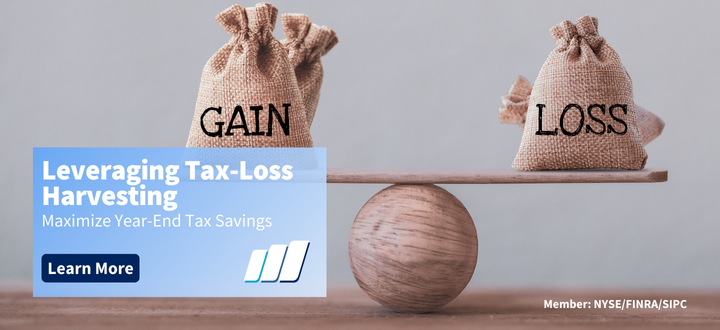
November is a good time to review your portfolio as we head into the final days of 2024. You will want to look at your portfolio’s asset allocation as well as evaluating the holdings in your portfolio. This is a good time to look for holdings with unrealized losses in your taxable accounts. While rebalancing your portfolio, or in your review of your holdings as you look to head into the new year, harvesting tax-losses can help reduce your overall taxes for the year. How Does Tax-Loss Harvesting Work? Tax-loss harvesting involves selling holdings with unrealized losses in your taxable investment accounts and using the losses to offset capital gains or other income for the year. Capital losses are first matched with capital gains of the same type. Short-term losses and short-term gains Long-term losses and long-term gains Any remaining gain and losses of both types are then matched up. To the extent there are excess losses, up to $3,000 of those losses can be used to offset other income you may have. Any remaining losses can be carried forward to be used in a subsequent tax year.1 Tax-loss harvesting is a tax-efficient way to reduce or eliminate holdings from your taxable accounts and can also be very useful in rebalancing your portfolio. Note that while many advisors and investors focus on tax-loss harvesting at year-end, it is a great tool to use all year round. Beware of the Wash-Sale Rule The wash-sale rule says that investors cannot purchase an identical or a substantially equal security within a 61-day period of having sold a holding for a loss. This period includes the date of the sale, the 30 days prior and the 30 days afterwards. Violating the wash-sale rule will negate your ability to deduct the loss.2 Identical securities are relatively straightforward. If you sell XYZ stock for a loss you cannot purchase shares of XYZ stock within this 61-day period. This not only pertains to the account in which the sale transaction took place, but in all of your accounts, including other taxable accounts, IRAs, retirement accounts such as a 401(k) and all other accounts that you might own. Sometimes, the wash-sale rule can be violated unintentionally. Let’s say that you sold a portion of a mutual fund holding at a loss, but you still retain some shares. If during the wash sale rule, you receive a distribution from the fund and that distribution is reinvested, this would violate the rule. In looking to replace shares of a security that was sold at a loss, make sure the replacement holding is different enough from the holding that was sold at a loss. For example, if you sold a mutual fund in the large cap growth category, there are any number of other funds in that category that are likely substantially different from the fund you sold. Even if the fund you sold was an index fund, you should be able to replace it with another fund tracking a different index in the same fund category. Combining Tax-Loss Harvesting with Portfolio Rebalancing Tax-loss harvesting is an excellent tool to use with portfolio rebalancing all during the year, not just at year-end. Selling underperforming assets offers a chance to invest in other areas while maintaining your desired asset allocation and maximizing tax efficiency. Financial advisors generally recommend looking at your asset allocation throughout the year at regular intervals. This might be quarterly or semi-annually. While rebalancing your portfolio to get it back in line with your target asset allocation, you will need to sell a portion or the entire position in some holdings. In some cases, within your taxable account(s), this will result in a realized capital gain. In others it will result in a capital loss. Where possible, it is a good idea to look at the tax consequences of selling a holding while rebalancing, but this should not be the deciding factor in determining whether or not to sell the holding. When deciding which holdings to sell in your taxable accounts, always look for positions with an unrealized loss. Next, look at whether you feel the holding has solid upside potential, or if it makes sense to sell some or all of the position. If so, then it probably makes sense to sell those shares. To the extent this can be incorporated into your periodic rebalancing efforts, so much the better in terms of the overall tax impact. To learn more about tax-loss harvesting and how this can be a beneficial strategy contact your Wedbush advisor. 1: IRS 2: IRS Disclosure Wedbush Securities does not provide tax or legal advice. Please consult your tax or legal advisor. These materials are provided for general information and educational purposes based upon publicly available information from sources believed to be reliable — we cannot assure the accuracy or completeness of these materials. The information presented is not intended to constitute an investment recommendation for, or advice to, any specific person. The information presented here is not specific to any individual’s personal circumstances. To the extent that this material concerns tax matters, it is not intended or written to be used, and cannot be used, by a taxpayer for the purpose of avoiding penalties that may be imposed by law. Each taxpayer should seek independent advice from a tax professional based on his or her individual circumstances. The information in these materials may change at any time and without notice. Third-party entities, companies, and organizations that may be referenced on this page are not affiliated with Wedbush Securities or any of its affiliates. Opinions mentioned are that of the third-party and not of Wedbush Securities, the financial adviser and/registered representative, or any of our affiliates. Investment products involve investment risks including potential loss and are not insured by any federal agency, are not deposits or obligations of, or guaranteed by any financial institution and may involve loss of value. Past performance is not a guarantee of future returns. Any implementation of recommendations