

Why You Should Contribute to a 401(k)

If your employer offers a 401(k) or similar retirement plan for their employees, this can be an easy way to save for your retirement. Here are some things to know about 401(k)s plans and some things to consider when deciding whether to contribute. What is a 401(k) plan? A 401(k) plan is a defined contribution plan offered by many employers. The employer, often in conjunction with a financial advisor to the plan, will offer a number of investment options that employees can invest in via salary deferral contributions. Some employers offer matching contributions and may make profit sharing contributions to the plan. Defined contribution means that your retirement benefit is defined by the contributions made to the plan and how the investments you choose perform over time. Traditional 401(k) account contributions are made with pre-tax dollars offering a current year tax benefit. Some plans offer a designated Roth account as part of their plan. The advantage of these Roth accounts is that there are no income restrictions on your ability to contribute as with a Roth IRA. Most 401(k) plans offer a variety of investment options to choose from. These are generally mutual funds, but other types of pooled investment options are available in some plans. Choices may include: Money market or stable value funds Stock funds of various types across a number of asset classes Bond mutual funds Managed funds such as target date funds The ability to invest in company stock in some cases Advantages of a 401(k) plan There are a number of advantages to investing via a 401(k) plan. Higher contribution limits than with an IRA. For 2022 the limits are $20,500 plus a $6,500 catch-up contribution for those who are 50 or over. An easy way to dollar cost average. Pre-tax contributions or Roth contributions (if offered). Tax-advantaged growth of your investments. A professionally selected investment menu among the best plans. The opportunity of “free money” from employer matching if offered. Wider creditor protection than an IRA. Many plans have an auto rebalancing feature that allows you to rebalance your account in line with your desired asset allocation on a periodic basis. Many plan sponsors take their fiduciary responsibilities very seriously and work with solid outside advisors and investment managers to ensure they offer top notch investments and that they keep expenses low. Disadvantages of a 401(k) An investment menu that is limited to what is offered in most cases. If the plan is not well-run the investment options may be sub-par. Restrictions on accessing your money if needed while you are working. Not all plans offer low-cost investments. Both traditional and Roth accounts are subject to required minimum distributions. It’s important to understand what is both good and bad about your employer’s plan before investing, and to review the plan periodically over time. The importance of consistently contributing to your 401(k) plan The biggest reason to contribute consistently to your company’s plan is that this is an easy, painless way to save for retirement. The money comes right out of your paycheck, there is no need to write a check to the account. Once you get in the habit of contributing you likely won’t miss the money each payday. Normally it is a good idea to contribute as much as possible up to the contribution limits each year. Even in a subpar plan, if the employer matches your contribution you will want to contribute enough to get the full match. This is free money, pure and simple. Money in your 401(k) can be rolled over to an IRA when you leave the company, or to a new employer’s plan if allowed. This allows you to work with your advisor to manage these assets in line with the rest of your portfolio and to maintain the tax-advantaged status of this money. Additionally, for those who want to accumulate more in a Roth account, there are no income limits on contributions. You can contribute up to the maximum contribution limits in any given year. Contact your Wedbush advisor to discuss your company’s 401(k) and how to utilize it to your best advantage in light of your overall financial strategy. Looking to build a financial plan based on your goals while considering market trends and risk factors? Click here to check out our approach to Wealth Management. Disclosure These materials are provided for general information and educational purposes based upon publicly available information from sources believed to be reliable — we cannot assure the accuracy or completeness of these materials. The information presented is not intended to constitute an investment recommendation for, or advice to, any specific person. The information presented here is not specific to any individual’s personal circumstances. To the extent that this material concerns tax matters, it is not intended or written to be used, and cannot be used, by a taxpayer for the purpose of avoiding penalties that may be imposed by law. Each taxpayer should seek independent advice from a tax professional based on his or her individual circumstances. The information in these materials may change at any time and without notice.
Roth IRA vs. Traditional IRA – Which One is Right for You?
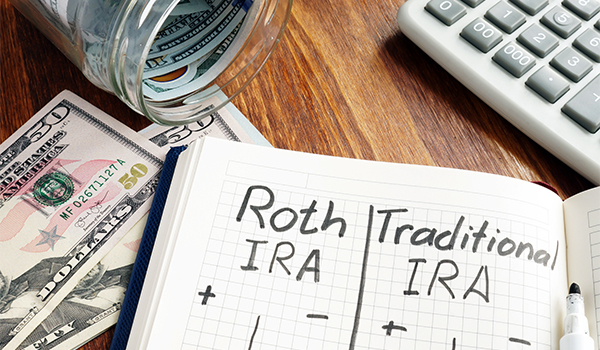
The IRA is a retirement account for individuals that offers an accessible retirement savings vehicle for all investors. Money can be contributed directly or rolled over from an employer retirement account like a 401(k). There are two types of IRAs, here is a look at both the traditional and Roth IRA to help you decide which is right for you. For both 2021 and 2022 the contribution limits for both types of IRAs combined is $6,000 with an extra $1,000 catch-up contribution for those who are 50 or over. Contributions for the 2021 tax year can still be made through April 15, 2022. Roth IRA Overview Roth IRA contributions are made on an after-tax basis. The money in the account grows tax-free and can be withdrawn tax-free if certain conditions are met. These include being at least age 59 ½ and having met the applicable five-year rule for the account pertaining to contributions and/or conversions and rollovers into the account. If you are younger than 59 ½ and don’t meet certain requirements, then your withdrawal could be subject to taxes and/or a 10% penalty. There are income restrictions on your ability to contribute to a Roth IRA. They are based on your MAGI (modified adjusted gross income). For 2021 and 2022, the limits are: There are a number of pros and cons to a Roth IRA. Some of the Pros include: Withdrawals are tax-free in retirement if certain requirements are met. Your contributions to the account can always be withdrawn tax-free. There are no required minimum distributions (RMDs) for a Roth IRA. Some of the cons include: There is no tax break for contributions in the year they are made. If your income is too high you cannot contribute to a Roth IRA. A Roth IRA is best for someone who: Is likely to be in a high tax bracket in retirement. Who wants to avoid the impact of RMDs. Who wants to be able to pass IRA assets to non-spousal beneficiaries tax-free. Traditional IRA Overview Traditional IRA contributions can be made on a pre-tax basis. If you are covered by a retirement plan at work, such as a 401(k), then there are income limitations on the amount that can be contributed pre-tax. If your pre-tax contributions are limited or prohibited, you can make after-tax contributions to the account up to the $6,000/$7,000 limits. Withdrawals from a traditional IRA are taxed as ordinary income with the exception of the value of any after-tax contributions. Withdrawals prior to age 59 ½ may be subject to a 10% penalty, with some exceptions. There are income restrictions on your ability to contribute on a pre-tax basis to a traditional IRA if you are covered by a workplace retirement plan. They are based on your MAGI (modified adjusted gross income). For 2021 and 2022, the limits are: Note there are additional restrictions in situations where you are not covered by a plan at work, but your spouse is if you are married. There are a number of pros and cons to a traditional IRA: Some of the Pros include: Pre-tax contributions are available if you meet the income requirements. Your investments grow on a tax-deferred basis. Some of the cons include: Distributions from the account are taxable. Traditional IRAs are subject to required minimum distributions. Your ability to make pre-tax contributions may be limited if you are covered by a retirement plan at work if you earn too much. A traditional IRA is best for someone who: Is likely to be in a lower tax bracket in retirement. Who wants to take advantage of the ability to make pre-tax contributions if eligible. James Bailey of Bailey & Quinn Financial Consulting Group says, “As a rule of thumb for those considering a Roth or traditional IRA, the anticipated tax bracket at retirement is key. If you think you’ll be in a higher bracket when you retire, a Roth IRA may be the better choice.” Contact your Wedbush advisor to discuss which type of IRA is best for you and how to best manage an existing IRA account. Looking to build a financial plan based on your goals while considering market trends and risk factors? Click here to check out our approach to Wealth Management. Disclosure These materials are provided for general information and educational purposes based upon publicly available information from sources believed to be reliable — we cannot assure the accuracy or completeness of these materials. The information presented is not intended to constitute an investment recommendation for, or advice to, any specific person. The information presented here is not specific to any individual’s personal circumstances. To the extent that this material concerns tax matters, it is not intended or written to be used, and cannot be used, by a taxpayer for the purpose of avoiding penalties that may be imposed by law. Each taxpayer should seek independent advice from a tax professional based on his or her individual circumstances. The information in these materials may change at any time and without notice.
Small Businesses/Self-Employed: Which Retirement Plan is Right for You?

Those who are self-employed or who own a small business need to save for their own retirement. They need to take the initiative and get started. Unlike with a larger employer who offers a retirement plan, you are responsible for doing this yourself to ensure that you have sufficient assets available to you when you retire. For California Businesses: California small businesses that don’t offer a retirement plan for their employees may be forced to register for the CalSavers program. Companies with 5 to 50 employees have until June 30 to enroll. The deadline for larger companies to enroll has passed, but they may still be able to register and avoid penalties. While the CalSaver program is well-intentioned, most companies can do better for the owner and the employees by working with a financial advisor to establish a plan that better meets their needs. This might be a small business 401(k), a SIMPLE IRA or even a SEP-IRA. Here is a look at some of the retirement savings options to consider. IRAs IRAs are available to anyone who has earned income. You open an account, contribute money and start investing. Some key points about IRAs: Contribution limits for 2021 and 2022: $6,000 plus a $1,000 catch-up for those 50 and over. Available as traditional or Roth IRAs. There are income limitations for Roth contributions and for pre-tax contributions for those who are covered by a workplace retirement plan. Not available for employees. Money grows tax-deferred in a traditional IRA and tax-free in a Roth. Withdrawals are tax-free from a Roth IRA if certain conditions are met. Solo 401(k) Available for business owners, their spouses involved in the business and business partners. Employees who do not meet the above criteria cannot participate. Contribution limits are the same as a workplace 401(k). The business can make profit sharing contributions up to 25% of your compensation up to a maximum of $61,000 and $67,500 for those who are 50 or over in 2022. Easy to open at most major custodians, paperwork is minimal. Roth options may be available depending upon the custodian. SEP-IRA Available for the self-employed plus businesses with employees. Contributions are made by the employer only, there are no employee contributions. There is no Roth version available. A SEP-IRA can be started and funded up to the tax filing due date for the company, including extensions. Contributions are made as a percentage of owner and employee compensation, up to 25%. Business owners must contribute the same percentage to any eligible employees as they do for themselves, making this potentially an expensive option for a business with employees. The maximum contribution for 2021 is $58,000 for 2021 and $61,000 for 2022. There are no additional contributions for those who are 50 or over. The contributions offer a tax break to the business, including sole practitioners. SIMPLE IRA The SIMPLE IRA is available to the self-employed and to businesses with up to 100 employees. Employee contributions are tax deductible. Employers must make a minimum contribution to each employee’s account of up to 3% of compensation or a flat 2%. The maximum employee contribution is $14,000 for 2022 with an additional $3,000 available as a catch-up contribution for those 50 or over. SIMPLE IRAs require minimum paperwork and were designed to be an easy option for small businesses. There is no Roth option available with a SIMPLE IRA. A rollover from a SIMPLE IRA will be assessed a steep penalty if the rollover is made within the first two years since an employee has made their first contribution, unless the rollover is to another SIMPLE IRA plan. Employer contributions and costs of running the plan are tax deductible to the company. Small Business 401(k) There are a number of providers that offer 401(k) plans tailored to smaller companies. These plans offer the chance for the company’s employees and the owner to build retirement savings. The plan can offer auto-enrollment whereby each employee is automatically enrolled in the plan with contributions to a QDIA (qualified default investment alternative). This ensures that each employee is saving something and can help the plan avoid failing its annual non-discrimination testing, which could limit the ability of the owner and other highly compensated employees to contribute the full amount to the plan. Safe harbor plans provide a minimum employer contribution to all employees. In exchange for this, the employer gets a pass on its annual plan testing. Some small business plans do not offer great investment options and may be quite expensive for the participants and for the employer. The employer receives a tax deduction for any contributions to the employees as well as any out-of-pocket costs associated with running the plan. A Roth option can generally be added to the plan. Defined Benefit Plan A defined benefit plan is a traditional pension plan. DB plans can be implemented for the self-employed as well as for a small business. Defined benefit plans offer a set retirement benefit for business owners and employees. They are funded by the employer. The plan typically offers a benefit based on years of service and compensation. The employer receives a tax benefit for contributions to the plan and for the costs associated with administering the plan. Defined benefit plans can be very expensive for the employer, including funding requirements, the need for an actuarial valuation and other expenses. Funding the plan is mandatory, defaulting on the plan obligations could put the company out of business. Andrew Hutcheson, SVP and Branch Manager of Wedbush in Pasadena, CA says, “The decision to implement a company retirement plan is very important. It is imperative that you not rush into the decision as it can be hard to make changes once a plan has been started. A financial advisor who specializes in retirement plans should be consulted from the very beginning.” He adds, “If the advisor doesn’t have the proper expertise, then they might not be informed regarding all of the nuances that the changing regulatory environment can